
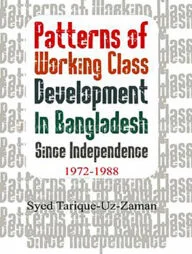
Patterns of Working Class Development In Bangladesh Since Independence 1972-1988
This book is based on the Ph. D Thesis of the writer which explores the Marxian theory of workers emancipation and its validity in case of Bangladesh after its independence in 1971,especially in the context of the growth pattern of its emerging working cl| লেখক | সৈয়দ তারিক উজ-জামান |
| প্রকাশনী | |
| সংস্করণ | May 22, 2026 |
| catagory | রাজনীতি বিষয়ক বই |
| Language | : ইংরেজি |
| Number of Pages | 312 |
| Cover Type | Unknown Cover |
This book is based on the Ph. D Thesis of the writer which explores the Marxian theory of workers emancipation and its validity in case of Bangladesh after its independence in 1971,especially in the context of the growth pattern of its emerging working class. In the 1960-1970s,it was the time of vibrant global socialist movement and its fervor was felt everywhere,every nook and corners of the 6 continents; thus in that context Bangladesh examining the social realities of the expected success was felt necessary.br At first it explores Marxian and different Marxists’ theories on the consequence of emerging capitalism and its concomitant working class development,in terms of quantity as well as quality; a rise of a new big class of people with different qualities,hopes and aspirations and capable agent of social change; not in an evolutionary process but in a revolutionary method. Actually Marx developed a kind of socio-economic model of social revolution based on some socio-economic assumptions,and declared that it would be inevitable in all capitalist societies given the assumptions remain constant,and the birth and fast growing of the variable of social change,the modern working class or the proletariat,their grave diggers. This new class of people not only grow in numbers along the capitalist development,but also grow in quality,with totally newer mentalities,attitudes,capacities,and finally a kind of class consciousness,which grow through alienation from previous rural roots,agriculture,means of production etc.,those were not found in case of previous exploited classes. Class consciousness again has two levels,at the lower level it is called class in itself,when they just got united in trade unions and understands its utility for achieving immediate demands,class interest collectively,and at the upper level with full consciousness of its role of social change,change qualitatively with social revolution,called class for itself.br Thereafter an empirical study was conducted to see the realities of Bangladesh a